

Nuova pubblicazione
È disponibile una nuova pubblicazione. Scopri di più, clicca qui
By Amanda Minervini
For many years I have traveled throughout Italy with my American students, and for some time we sojourned in Campania. Without giving my students too much background information, I took them to visit some of the famous estates where the Water Buffaloes (Bubalus bubalis) are supposedly “massaged and happy,” and where, as a result, the mozzarella and the meat are said to be “even more delicious” and “heavenly.” Over the years, the wide range of reactions shown by the students struck me, from horror at the animals’ conditions to complete indifference, underscored by their immediate requests to taste the ice cream made from buffalo milk. What I am writing here is not the result of some secretive investigative inquiry, but simply what any tourist can see at any one of these estates. If they want to see.
Every time I hear talk of “happy buffalo”—the ones that, in promotional videos and articles, listen to music, scratch themselves on rotating brushes, and live a bucolic life on lush green meadows—I feel a deep anger. For years we have been accustomed to a pastoral imaginary, as if buffalo mozzarella were the natural result of a harmony between human beings, territory, and animal. But it only takes a little digging—and the reading of some scientific studies, not activist investigations—to discover that the truth is very different. In fact, a quick tourist visit to one of the famous “happy” masserie, perhaps after a visit to the beautiful Paestum, is enough to realize that it is… quite simply a hoax. In all my visits I have never heard a single musical note, and the brushes meant to relieve the poor buffaloes’ itching were always malfunctioning. The poor buffaloes looked quite shut down or clearly unhappy.
The buffalo is an animal whose psychophysical well-being depends on access to water and humid environments (Napolitano et al., 2007; De Rosa & Grasso, 2012); they have coarse coat and skin that are particularly prone to itching. Ethological literature documents how grazing and the possibility of immersing themselves in or standing in water are fundamental natural behaviors. Deprivation of these elements causes stress and a higher incidence of lameness and hoof problems—a phenomenon well documented in dairy cattle raised on concrete, and one that applies even more strongly to buffalo (Cook & Nordlund, 2009). Intensive buffalo farming in Campania has by now become the norm rather than the exception. As early as twenty years ago, Masucci et al. (2003) identified significant critical issues in Campanian buffalo farms, including organic ones, using the ANI (Animal Needs Index). The study revealed problems of insufficient space, lack of stimulation and environmental enrichment, and suboptimal sanitary conditions. It is painful to think that what was already problematic then has now become structural: extremely high stocking densities, concrete flooring, and inadequate hygienic conditions.
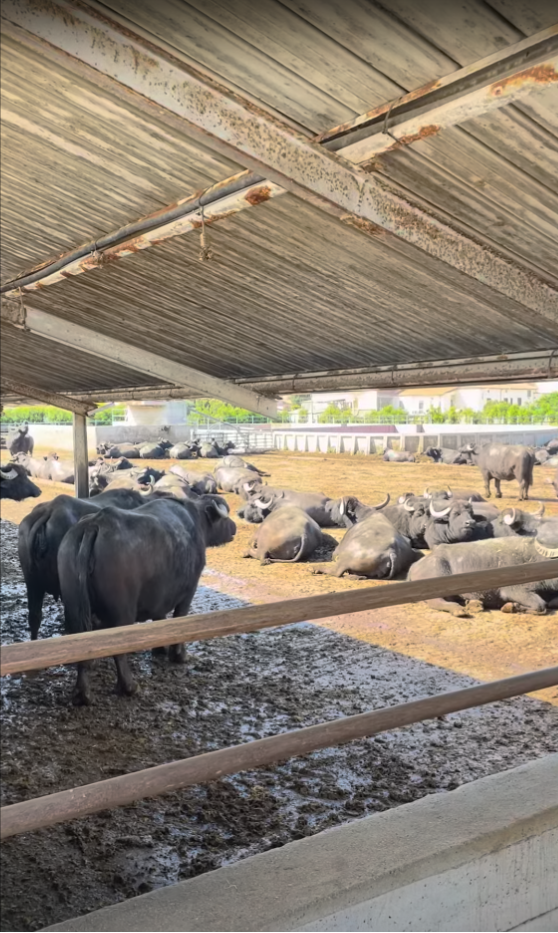
[The real conditions of the Water Buffaloes during a typical tourist visit: no grazing, no music, and no brushes for scratching. The buffaloes clearly display anxiety, distress, suffering, or complete dejection and apparent withdrawal. All photographs in this article are by the author.]
When I read scientific reports such as those by Campanile et al. (2010), which analyze the physiology of lactating buffalo, I realize just how fragile these animals’ biological balance is. Water Buffaloes, like cows of course, are not “milk machines,” as they are so often treated: they are animals with specific ethological needs, including humid environments and opportunities for movement. Intensive confinement, combined with production pressure, profoundly alters their well-being.
And then there is the issue of the calves, perhaps the most emotionally striking aspect. Early separation from their mothers is a widespread practice, even though the literature on maternal behavior in cattle demonstrates the importance of the mother–offspring bond for reducing neonatal stress and for proper behavioral development (von Keyserlingk & Weary, 2007; Flower & Weary, 2003). Studies on the psychological impact of early separation in cows report prolonged vocalizations, agitation, reduced feed intake, and stereotyped behaviors—phenomena also observed in buffaloes, as documented by De Rosa et al. (2009). In the so-called “happy buffalo” farms, the calves are left with their mothers for just 10 days, then they spend a few weeks alone in dark cages, facing high mortality rates and harsh conditions. These calves are not even hidden—just take a turn from the dirty and overcrowded dry lots where adults are kept, and you will find the babies. Even the manure collected each month for biomass production generates roughly €50,000 per month, so revenues are certainly not lacking, and they could easily be reinvested to improve the welfare and care of these animals, which are also undeniably intelligent and sensitive (this is not to say that intelligent animals deserve more welfare than others: all life does).
None of this appears in the glossy brochures of the masserie. Rather than practices genuinely aimed at animal welfare, classical music and rotating brushes function instead as a way to distract consumers and to cleanse their consciences. The academic literature is clear: animal welfare cannot be entrusted to gadgets or to anthropocentric, capitalist ideals, but depends on species-specific environments, such as access to pasture, adequate space, quality of management, animal autonomy, and respect for natural behaviors (Fraser, 2008). Even the much-celebrated “smart farm” technologies prove ambiguous when examined in light of ethological research. Automation may facilitate management and increase production, but if animals remain confined on concrete for their entire lives, the impact on welfare is marginal at best (Gasparotto et al., 2021). Digital technologies alone do not replace what ethologists call “natural living” or a “species-appropriate environment”—one of the three fundamental pillars of animal welfare.
On the health front, controversies surrounding culling for suspected brucellosis and tuberculosis raise further questions. Several technical and parliamentary reports have shown that culling has involved enormous numbers of animals, far exceeding those that actually tested positive, generating conflict between farmers and institutions (Senate of the Republic Report, 2022). No scientific studies are needed to understand that when a farming system is fragile, overcrowded, and stressed, disease finds fertile ground. This is basic epidemiology. Veterinary literature adds another crucial element: the accumulation of manure, if not properly managed, increases the risk of mastitis, hoof infections, and environmental contamination (Smith, 2002). A clean barn is not merely an aesthetic concern; it is a structural condition of animal health.
I cannot help but think that all of this must change—not out of idealism, but because science tells us so. Studies on extensive farming systems show that greater access to the outdoors reduces stress, disease, neonatal mortality, and the need for antibiotics (Olmos et al., 2009). Is a more ethical supply chain therefore possible? Yes, but only if the animal—rather than productivity—is placed back at the center of the system.
[May 2024, buffalo calves kept in complete isolation in dark cages exhibiting stereotyped behaviors.]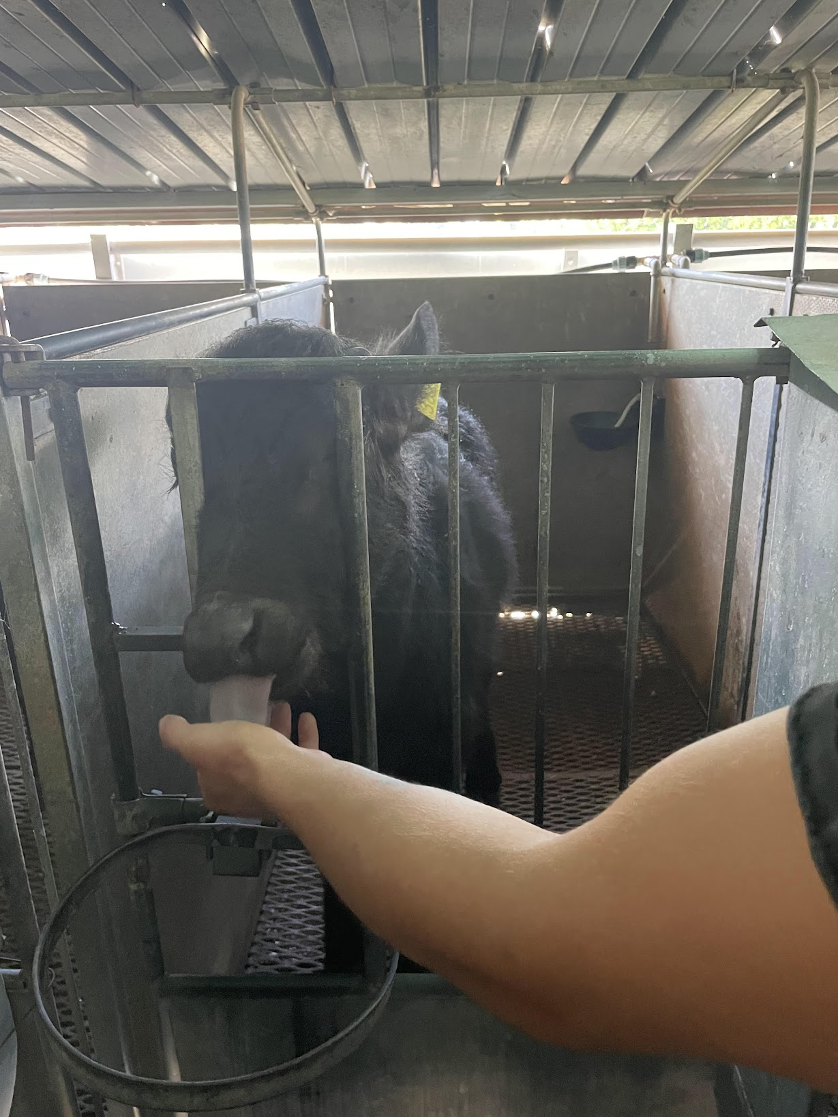
At this point, consumers should at least demand the truth. If we truly want to speak of “happy buffaloes,” then we must ensure that they really are: that they have space, grass, water, maternal bonds, and dignity. In the case of dairy animals, calves should not be prematurely separated from their mothers simply to ensure that all the milk can be commercialized. If we pride ourselves on being an evolved species, we are surely capable of reserving part of the milk for the calves, without having to remove them entirely from their mothers—or at least from a “nurse” cow.
Even if science did not tell us this, a minimum of empathy would suffice, which is also a matter of ethics. But as time goes on, I increasingly feel that, at the very least, we ought to listen to science.
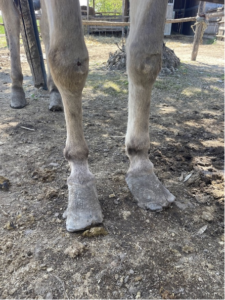
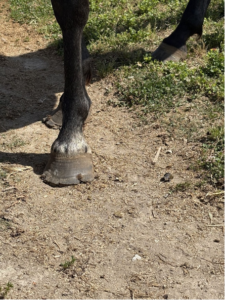
[Other animals living on these estates are also kept in conditions of neglect, with the approval of the veterinarians responsible for the estates (who ignore every report). Unfortunately, I have encountered a great deal of insensitivity among Italian veterinarians who work with farm animals, a trait that normally does not characterize this profession.]
Bibliografia
Campanile, G., Neglia, G., Di Palo, R., Gasparrini, B., Vecchio, D., Russo, M., & Zicarelli, L. (2010). Physiological and productive responses of dairy buffaloes to different feeding and management systems. Italian Journal of Animal Science, 9(2), 245–257.
Cook, N. B., & Nordlund, K. V. (2009). The influence of the environment on dairy cow behavior, claw health and herd lameness dynamics. Veterinary Journal, 179(3), 360–369.
De Rosa, G., Grasso, F., & Napolitano, F. (2009). Metodologie di valutazione del benessere nelle bufale da latte. Large Animal Review, 15(3), 123–130.
De Rosa, G., & Grasso, F. (2012). Behaviour and welfare of buffaloes. Italian Journal of Animal Science, 11(2), 220–230.
Flower, F. C., & Weary, D. M. (2003). The effects of early separation on the dairy cow and calf. Applied Animal Behaviour Science, 80(4), 301–318.
Fraser, D. (2008). Understanding animal welfare: The science in its cultural context. Wiley-Blackwell.
Gasparotto, P., et al. (2021). Precision livestock farming and dairy buffalo production: limits and opportunities. Frontiers in Veterinary Science, 8, 1–12.
Masucci, F., Di Francia, A., De Rosa, G., & Grasso, F. (2003). Problematiche alimentari e del benessere animale in aziende bufaline della Campania. Università degli Studi di Napoli Federico II.
Napolitano, F., Pacelli, C., Grasso, F., & De Rosa, G. (2007). The behavior and welfare of buffaloes (Bubalus bubalis) in dairy farms. Italian Journal of Animal Science, 6(S1), 333–336.
Smith, K. L. (2002). Mastitis in dairy animals: a review. Journal of Dairy Science, 85(5), 1141–1149.
Von Keyserlingk, M. A. G., & Weary, D. M. (2007). Maternal behavior in cattle. Hormones and Behavior, 52(1), 106–113.
Olmos, G., Boyle, L., Hanlon, A., Patton, J., Murphy, J. J., Mee, J. F. (2009). Calf health and behaviour in dairy systems with high versus low outdoor access. Applied Animal Behaviour Science, 120(1–2), 35–41
